Custom Peptide Synthesis
Executive Summary
QYAOBIO has delivered research-grade custom peptides to academic and pharmaceutical laboratories worldwide since 2008. Our synthesis platform supports sequences from 5 to 150 amino acids across all purity grades — from crude screening peptides to >98% purified products for structural biology and assay development. With over 400 validated modification methods, we handle the full spectrum of peptide chemistry requirements for drug discovery, immunology, neuroscience, and structural biology research.
We produce exclusively for research use. Our peptides are not intended for human therapeutic or diagnostic applications. This focus allows us to optimize every aspect of our process — synthesis chemistry, purification protocols, and analytical methods — for the specific needs of the research community.
Scientific Background: Solid-Phase Peptide Synthesis (SPPS)
Our peptide synthesis is built on Fmoc-based Solid-Phase Peptide Synthesis (SPPS), the gold standard for research and industrial peptide production. In SPPS, the peptide chain is assembled stepwise on an insoluble resin support. Each cycle involves:
- Deprotection — Removal of the N-terminal Fmoc protecting group
- Coupling — Activation and attachment of the next amino acid
- Cleavage — Final release from the resin with simultaneous side-chain deprotection
This approach enables precise control over sequence, minimizes side reactions, and allows incorporation of non-standard amino acids and chemical modifications at defined positions. Our chemists routinely optimize coupling conditions for difficult sequences, achieving a >95% first-pass success rate.
Key Advantages of SPPS
- Precision: Each amino acid is added in a defined order, eliminating sequence errors that can occur in recombinant methods
- Chemical Diversity: Non-proteinogenic amino acids, D-isomers, and synthetic modifications are incorporated with the same efficiency as standard residues
- Scalability: The same chemistry works from milligram research scale to kilogram production, with no fundamental change to the process
- Purity: Stepwise assembly combined with preparative HPLC yields products that meet the >98% purity standards required for structural biology and in vivo pharmacology
Service Specifications
| Parameter | Standard Range | Extended Capability |
|---|---|---|
| Sequence Length | 5–50 amino acids | Up to 150 amino acids |
| Purity Levels | Crude, >75%, >90%, >95%, >98% | >99% (inquiry) |
| Quantity | 1 mg – 100 g | Up to kilogram scale |
| Modifications | 400+ methods | Custom development available |
| Turnaround Time | 2–3 weeks (standard) | 1 week (rush available) |
| QC Documentation | HPLC + LC-MS + COA | Mass spectrometry, amino acid analysis |
| Shipping Format | Lyophilized | Custom aliquoting available |
Available Modifications
N-Terminal Modifications
Acetylation, biotinylation, fatty acid conjugation (C2–C18), fluorophore labeling (FITC, 5-FAM, TAMRA, Cy3, Cy5), DOTA/DTPA chelation
C-Terminal Modifications
Amidation, esterification, aldehyde functionalization
Internal Modifications
Phosphorylation (Ser, Thr, Tyr), biotinylation (Lys side chain), PEGylation (PEG2–PEG24), glycosylation, methylation, acetylation
Structural Modifications
Cyclization (lactam, disulfide, head-to-tail), stapled peptides (hydrocarbon and lactam staples), branch peptides, multiple disulfide bonds
Specialized Modifications
FRET pairs (donor-acceptor combinations), isotopic labeling (13C, 15N), D-amino acid incorporation, unnatural amino acids, click chemistry handles (azide, alkyne, DBCO)
Contact us with your specific modification requirements — custom development is available for novel modifications.
Quality Control
Every peptide undergoes rigorous quality verification before release:
- HPLC Analysis: Purity determination by reverse-phase HPLC at 220 nm
- LC-MS: Molecular weight confirmation within ±1.0 Da of theoretical mass
- Certificate of Analysis (COA): Complete documentation including HPLC chromatogram, MS spectrum, peptide content, solubility recommendations, and storage conditions
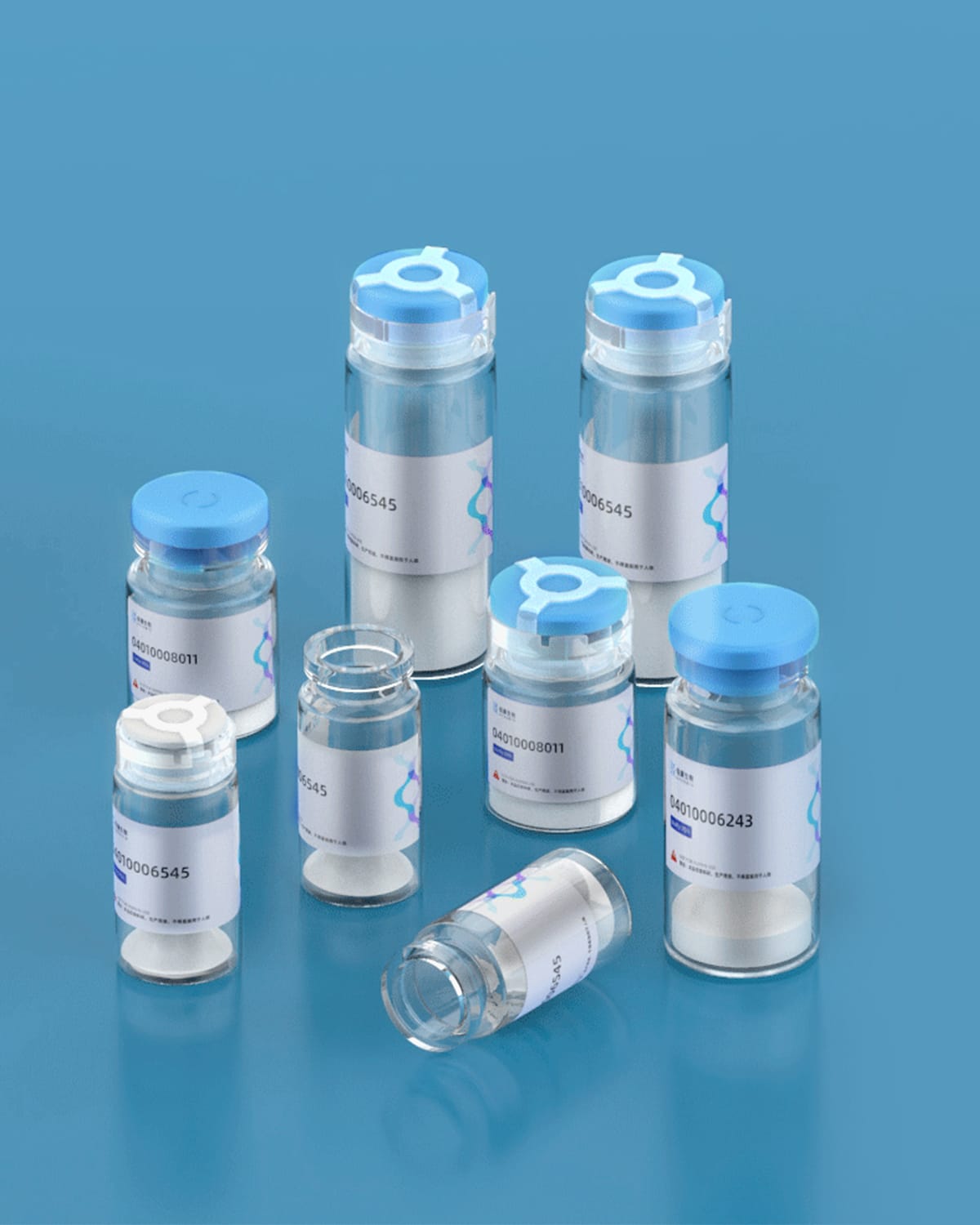
Peptides are shipped in lyophilized format for maximum stability. Custom aliquoting and solubility testing are available upon request.
Applications
Drug Discovery & Development
Screening libraries, lead optimization, SAR studies, peptide-based therapeutics, peptide-drug conjugates
Immunology Research
T-cell epitopes for vaccine development, MHC-binding peptides, immunodominant epitope mapping, adjuvant-conjugated peptides
Structural Biology
Crystallization-grade peptides (>98% purity), isotopically labeled peptides for NMR studies, co-crystallization ligands
Neuroscience
Neuropeptide synthesis, receptor-ligand interaction studies, ion channel modulators, behavioral pharmacology tools
Research Evidence
| Finding | Data | Source |
|---|---|---|
| Peptide therapeutics market projected growth | $46.6B → $89.4B by 2033 (CAGR 6.7%) | Precedence Research, 2024 |
| Peptide drugs in clinical pipeline | 200+ peptide therapeutics in clinical development | Lau & Dunn, Bioorg. Med. Chem., 2018 |
| SPPS remains the dominant synthesis method | >90% of commercial peptide production uses SPPS | Merrifield, J. Am. Chem. Soc., 1963 (Nobel Prize 1984) |
| Modified peptides improve bioavailability | PEGylation extends circulation half-life by 10–100× | Veronese & Pasut, Drug Discov. Today, 2005 |
| Peptide stapling improves cell permeability | Hydrocarbon stapling increases helical content and cellular uptake | Walensky & Bird, J. Med. Chem., 2014 |
Frequently Asked Questions
How much does custom peptide synthesis cost?
Pricing depends on sequence length, purity level, quantity, and modification complexity. A standard 10-mer at >95% purity, 10 mg scale typically ranges from $150–$300. Long peptides (>40 AA), difficult sequences, and complex modifications increase cost proportionally. We provide free, no-obligation quotes — email your sequence to aaron@senobiocorp.com.
What is the turnaround time?
Standard turnaround is 2–3 weeks for linear peptides up to 30 amino acids. Longer sequences, complex modifications, and very high purity requirements may take 4–6 weeks. Rush service with 1-week delivery is available for many projects at an additional fee.
What purity level do I need for my application?
Crude or desalted is sufficient for initial screening and ELISA. >95% is recommended for most in vitro assays, cell-based studies, and immunology work. >98% is required for structural biology (crystallography, NMR), in vivo studies, and publication-quality data.
Can you handle difficult sequences?
Yes. Sequences prone to aggregation, aspartimide formation, or beta-sheet formation are flagged during our feasibility assessment. We optimize coupling conditions and may recommend pseudoproline dipeptides or modified synthesis strategies to improve yield and purity.
Do you provide peptide libraries?
Yes. We offer custom peptide libraries with 24–96 peptides per plate. Crude or >75% purity is standard for screening libraries. Contact us for high-throughput requirements.
What about peptide modifications — are they difficult?
With 400+ validated methods, most standard modifications are routine for our team. Novel modifications not in our library can be developed through collaboration. We provide post-modification QC data including HPLC and MS verification.
Do you have a minimum order quantity?
No fixed minimum. We accept orders from 1 mg for research evaluation. Pricing per milligram decreases substantially at higher quantities (100 mg+).
How do I submit my sequence?
Email your peptide sequence (single-letter code), desired purity, quantity, and any modification requirements to aaron@senobiocorp.com. You will typically receive a quote within 24 hours.