Technology Platform
Solid-Phase Peptide Synthesis (SPPS)
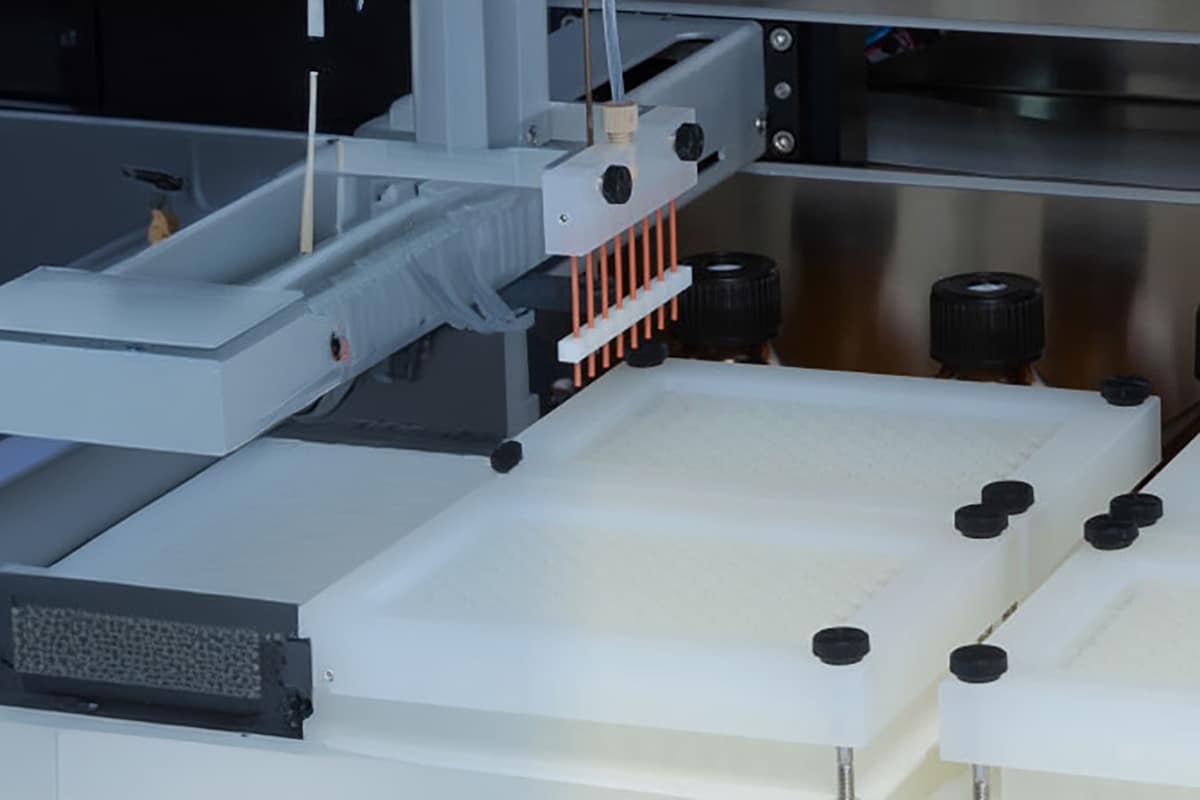
QYAOBIO’s synthesis platform is built on Fmoc-based Solid-Phase Peptide Synthesis (SPPS), the methodology for which R. Bruce Merrifield was awarded the 1984 Nobel Prize in Chemistry. The fundamental principle remains elegant: assemble the peptide chain step by step on an insoluble solid support, washing away excess reagents and byproducts after each coupling step.
The SPPS Cycle
Each amino acid addition proceeds through a three-stage cycle:
-
Fmoc Deprotection — The N-terminal Fmoc group is removed with 20% piperidine in DMF. The exposed amine is now ready for the next coupling.
-
Amino Acid Coupling — The incoming Fmoc-protected amino acid is activated with HBTU/HOBt or HATU/HOAt in the presence of DIEA, forming an activated ester that reacts with the resin-bound amine. For difficult couplings, our chemists deploy Oxyma/DIC chemistries or pseudoproline dipeptides.
-
Capping (optional) — Unreacted chains are capped with acetic anhydride to prevent deletion sequences from extending. This step is especially important for long peptides.
After assembly is complete, the peptide is cleaved from the resin with trifluoroacetic acid (TFA) containing scavengers appropriate to the sequence’s protecting groups. The crude peptide is precipitated, washed, and advanced to purification.
Handling Difficult Sequences
Peptide sequences present unique challenges: aggregation-prone stretches, aspartimide formation at Asp-Gly sites, and beta-sheet propensity that blocks coupling. Our 18 years of experience have produced a library of strategies:
- Pseudoproline dipeptides inserted at Ser/Thr positions disrupt interchain hydrogen bonding that causes on-resin aggregation
- Isoacyl dipeptide building blocks at Asp-Gly and similar “difficult sequence” junctions prevent aspartimide formation, a common side reaction that introduces impurities
- Microwave-assisted SPPS accelerates coupling and deprotection for sterically hindered residues in hydrophobic sequences
- Optimized solvent systems (NMP/DMSO mixtures) improve resin swelling and coupling efficiency for aggregation-prone sequences
- Fragment condensation assembles very long peptides (>80 amino acids) by synthesizing and purifying shorter protected fragments, then coupling them on resin or in solution
Quality Control System
Our quality control integrates analytical chemistry at every production stage:
Raw Material Incoming QC
Every amino acid derivative, resin, solvent, and reagent lot is tested before use. Only qualified suppliers with audited quality systems are approved for production use.
In-Process Monitoring
Cleavage of a small resin sample after synthesis completion provides a crude HPLC profile. Difficult sequences receive additional monitoring at intermediate chain lengths to verify coupling efficiency.
Final Product QC
Every peptide must pass:
- HPLC purity analysis at 220 nm and 280 nm (if aromatic residues present)
- LC-MS molecular weight confirmation (±1.0 Da of theoretical mass)
- Peptide content determination by amino acid analysis or nitrogen content (where applicable)
Results are compiled into a Certificate of Analysis (COA) that ships with every order.
Analytical Capabilities
| Technique | Instrument | Application |
|---|---|---|
| RP-HPLC | Agilent 1260 Infinity II | Purity analysis, preparative purification |
| LC-MS | Agilent 6120 Single Quadrupole | Molecular weight confirmation |
| UPLC-MS | Waters ACQUITY | High-resolution purity and MS |
| Mass Spectrometry | MALDI-TOF / ESI-MS | Sequence verification, impurity profiling |
| Amino Acid Analysis | Hitachi L-8900 | Peptide content, composition verification |
| Freeze Drying | Labconco / Christ | Final lyophilization, moisture ≤5% |
R&D Capabilities
QYAOBIO holds 20+ patents in peptide synthesis methodology and modification chemistry. Our R&D team continuously expands the modification library — now at 400+ validated methods — and develops custom solutions for novel customer requirements.
Recent R&D areas include:
- Macrocyclic peptide synthesis for drug discovery — cyclic peptides with enhanced proteolytic stability and conformational constraint for target engagement screening
- Site-selective bioconjugation chemistry enabling precise attachment of payloads, fluorophores, or affinity tags at defined positions without affecting biological activity
- Click chemistry handles (azide, alkyne, DBCO, TCO) incorporated during SPPS for customer-directed conjugation via copper-catalyzed or strain-promoted cycloaddition
- Stapled peptide methodology for cell-permeable alpha-helical peptides — a critical tool for targeting intracellular protein-protein interactions previously considered undruggable
- Isotopically labeled peptide production (13C, 15N) for quantitative proteomics and NMR structural studies
Frequently Asked Questions
What makes SPPS the preferred method for research peptides?
SPPS enables precise sequence control, straightforward purification, and the ability to incorporate non-standard amino acids and modifications at specific positions. It is scalable from milligrams to kilograms and is compatible with automated synthesis platforms for high throughput.
How do you ensure batch-to-batch consistency?
Every synthesis is documented with detailed batch records including resin lot, amino acid derivative lots, coupling conditions, cleavage time, and purification parameters. Final QC data (HPLC, MS) is archived and compared against specification. Repeat orders are cross-referenced against historical data.
What is the longest peptide you can synthesize?
Our standard capability extends to 150 amino acids. Sequences beyond this length are evaluated on a case-by-case basis and may be approached using fragment condensation or native chemical ligation strategies.
Do you work with non-standard amino acids?
Yes. D-amino acids, beta-amino acids, N-methyl amino acids, and a wide range of unnatural side chains are compatible with our SPPS platform. We maintain a stock of commonly requested non-standard Fmoc-amino acids.
Can you help with peptide solubility issues?
Yes. Our COA includes solubility testing results and recommendations. For difficult sequences, we can provide solubility optimization consulting, including advice on buffer composition, pH adjustment, co-solvents, and sequence redesign strategies such as adding solubilizing tags or substituting problematic hydrophobic residues.
Do you provide stability data?
Accelerated stability studies are available upon request. Standard COA documentation includes recommended storage conditions and lyophilized peptide moisture content (typically ≤5%). For projects requiring long-term stability data, we can design a study protocol tailored to your requirements.